Guide 02
Pre-foreclosure vs foreclosure
2 min read · updated October 29, 2026
The two words are used loosely, and the difference matters to anyone trying to buy. A pre-foreclosure has an owner you can talk to. A foreclosure has a sale you can bid at. Our records hold 3,508 Florida pre-foreclosure cases from 57 counties, with 1,360 first published in the last 30 days; Hillsborough County had the most, with 299.
Two stages of one process
Pre-foreclosure is the stage after a lender files to foreclose and before a sale is set; the owner still holds the title. Foreclosure, in the sense buyers use, is the stage after the court has ordered a sale, or the sale itself.
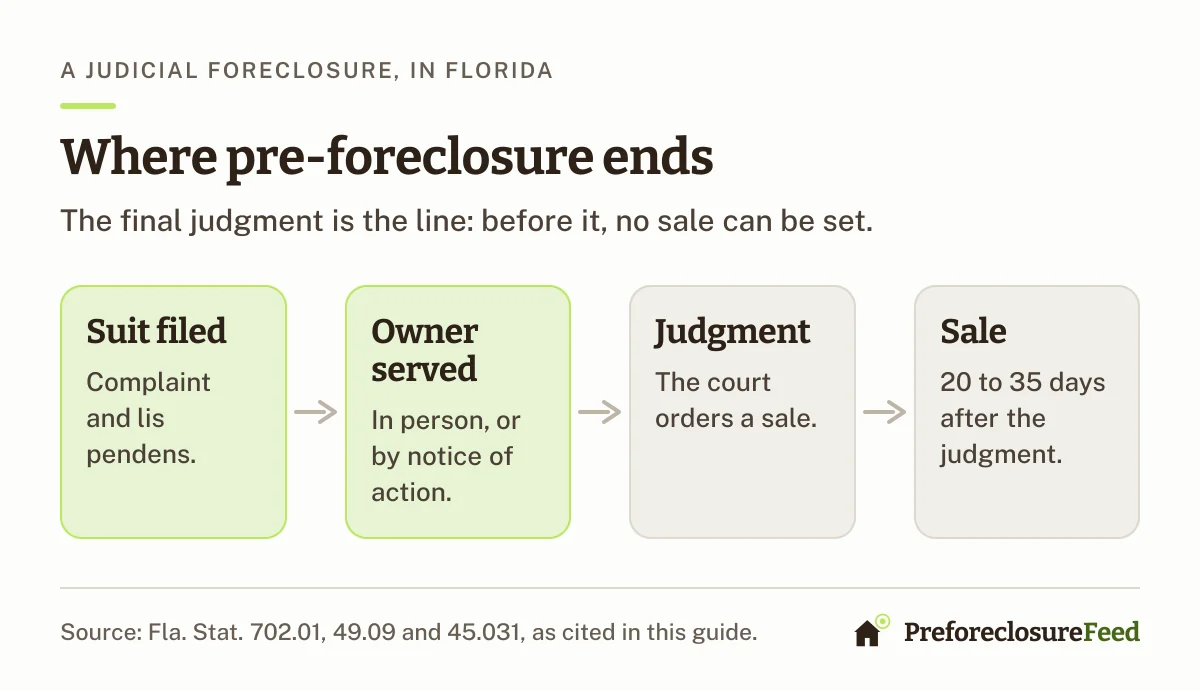
Take Florida, which forecloses through its courts: "All mortgages shall be foreclosed in equity" [1]. The lender files a complaint and records a lis pendens. The owners are served, in person or by a published notice of action. They have time to answer. Only when the court enters a final judgment does it "direct the clerk to sell the property at public sale on a specified day that shall be not less than 20 days or more than 35 days after the date thereof" [2]. Everything before that judgment is pre-foreclosure; the weeks after it, and the sale, are the foreclosure.
What the owner can still do
In pre-foreclosure the owner has the most room. They can sell on the open market or to a private buyer, pay off the loan from the proceeds and keep the equity. They can reinstate or refinance. They can apply for loss mitigation, and a complete application received more than 37 days before a sale stops the servicer from moving for judgment or holding the sale while it is reviewed [3].
The room shrinks once a sale is set, but it does not vanish at once. A Florida owner can still "cure the mortgagor's indebtedness and prevent a foreclosure sale" [4] until the clerk files the certificate of sale, or a later time the judgment sets. Curing at that stage means paying the whole judgment, which few owners can.
What a buyer deals with
| Pre-foreclosure | Foreclosure sale | |
|---|---|---|
| Who you deal with | The owner, privately | The clerk or trustee, in public |
| Terms | Negotiated: price, closing date, contingencies | Fixed by the sale: highest bid, deposit, fast payment |
| Inspection | Usually possible, with the owner's agreement | Usually none; the property is sold as it is |
| Financing | Ordinary, if the timeline allows | Usually cash |
| The existing loan | Paid off at closing, or a short sale the lender approves | Settled by the sale, as far as the bid goes |
| Competition | Other buyers writing to the same owner | Every bidder at the sale |
Where this list stops
Every case on PreforeclosureSearch is at the first stage. A notice that sets or reports a sale is a foreclosure, not a pre-foreclosure, and is left out. For how to work one of these cases from first letter to closing, read how to buy a pre-foreclosure home.
Sources
- [1]Fla. Stat. § 702.01 — Florida Legislature“All mortgages shall be foreclosed in equity.”
- [2]Fla. Stat. § 45.031(1)(a) — Florida Legislature“the court shall direct the clerk to sell the property at public sale on a specified day that shall be not less than 20 days or more than 35 days after the date thereof”
- [3]12 C.F.R. § 1024.41(g) (Regulation X) — Consumer Financial Protection Bureau“If a borrower submits a complete loss mitigation application after a servicer has made the first notice or filing required by applicable law for any judicial or non-judicial foreclosure process but more than 37 days before a foreclosure sale, a servicer shall not move for foreclosure judgment or order of sale, or conduct a foreclosure sale”
- [4]Fla. Stat. § 45.0315 — Florida Legislature“At any time before the later of the filing of a certificate of sale by the clerk of the court or the time specified in the judgment, order, or decree of foreclosure, the mortgagor or the holder of any subordinate interest may cure the mortgagor's indebtedness and prevent a foreclosure sale”
Questions
What is the difference between pre-foreclosure and foreclosure?
Pre-foreclosure is the stage after the lender starts foreclosing and before a sale is set; the owner still owns the home and can sell, reinstate or refinance. Foreclosure, as most buyers mean it, is the stage when a sale has been ordered or held. In a court-run state the dividing line is the final judgment of foreclosure.
Is it better to buy a pre-foreclosure or a foreclosure?
They are different deals. A pre-foreclosure is bought from the owner, with a normal contract, inspections and a title search, and usually needs the owner's lender to be paid off or to approve a short sale. A foreclosure sale is public and competitive, usually needs cash, and sells the property as it is. Pre-foreclosures take more patience and more people skills; foreclosure sales take more capital and more risk tolerance.
Does a pre-foreclosure always end in a foreclosure?
No. Many end with the owner reinstating, refinancing, selling, or agreeing a modification, short sale or deed in lieu with the servicer, and some suits are dismissed. A case leaves PreforeclosureSearch's list once a sale is set; it is no longer a pre-foreclosure.
Where next
- Pre-foreclosures by stateEvery state and county we cover, with new filings this week.
- Search every caseBy county, owner, lender, case number, street or ZIP code.
- Pre-foreclosure guidesWhat a pre-foreclosure is, how it differs from a foreclosure, Florida's lis pendens, and how to buy one.
- Pre-foreclosure glossaryLis pendens, notice of action, unknown heirs, reinstatement, deed in lieu: every term a filing uses.
General information about foreclosure law across the states, not legal advice. Foreclosure law differs from state to state and statutes change; confirm a case's docket with the clerk of court, and the rules that apply to you, before you act.