Guide 01
What pre-foreclosure means
3 min read · updated October 29, 2026
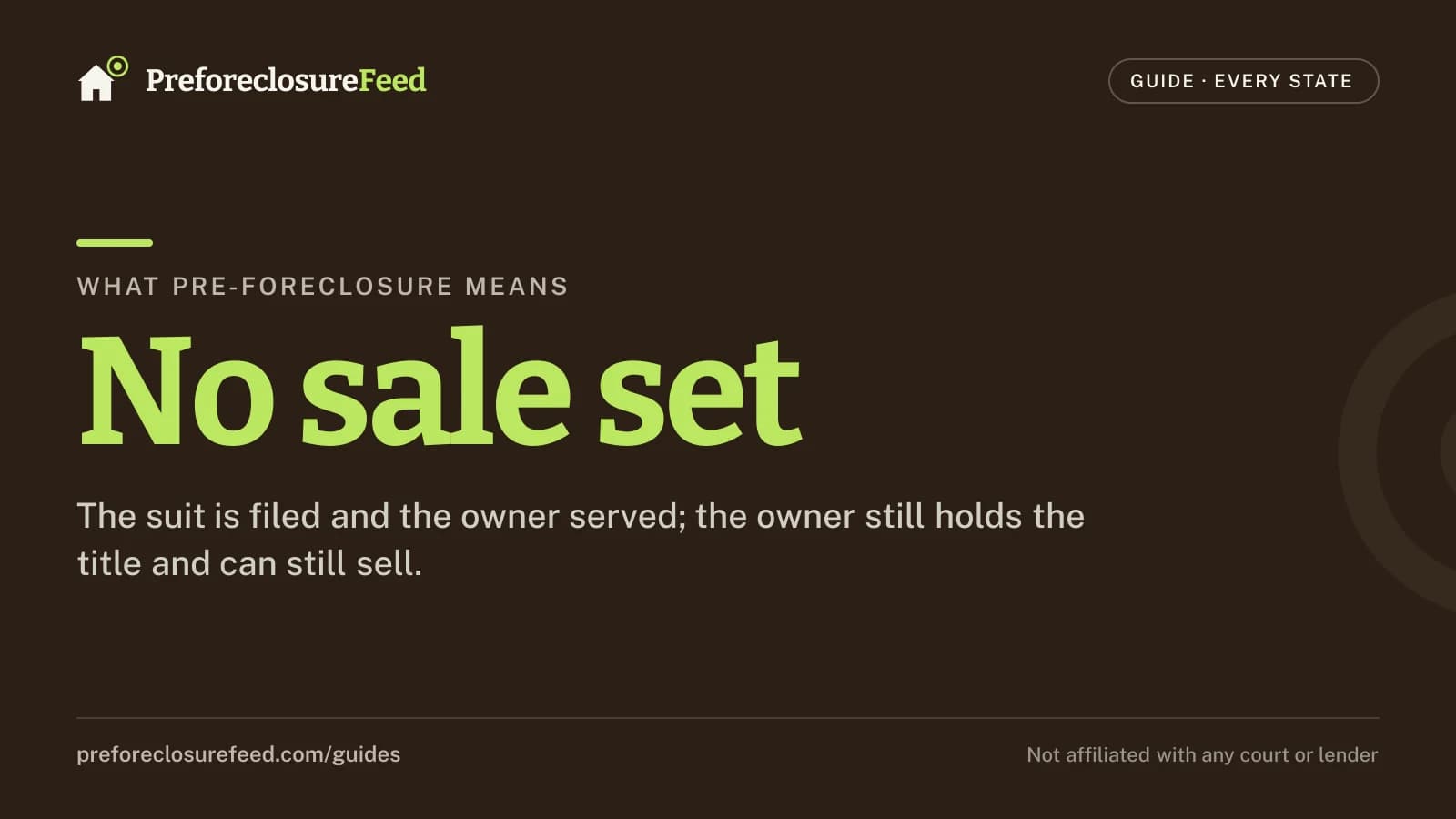
A home is in pre-foreclosure from the day the foreclosure becomes public until the day a sale is set. 9,413 cases on this site are at that stage right now, each one a suit filed and an owner served, with no sale on the calendar.
The stage between default and sale
Pre-foreclosure is the part of a foreclosure after the lender has started it in public, by filing a suit or recording a notice of default, and before any sale has been set. The owner still holds the title.
A missed payment is not a pre-foreclosure. Federal servicing rules make the public part start late: a servicer "shall not make the first notice or filing required by applicable law for any judicial or non-judicial foreclosure process" until the loan "is more than 120 days delinquent" [1], with narrow exceptions. By the time a case reaches this site the owner has usually been behind for months, and has had letters from the servicer the whole time.
What happens next depends on how the state forecloses. In a judicial state the lender sues in court. Florida is one: "All mortgages shall be foreclosed in equity" [2], which means through the circuit court. In a non-judicial state the lender records a notice of default and can sell without a suit, on a timetable the state's statute sets.
Why the timing matters
A sale is the end of the process, not the middle of it. In Florida, only once the court enters a final judgment does it "direct the clerk to sell the property at public sale on a specified day that shall be not less than 20 days or more than 35 days after the date thereof" [3]. Until that judgment, nobody can say when, or whether, the home will be sold.
That gap is the reason to look at pre-foreclosures at all. While the case is open the owner can still:
- Sell the home and pay off the loan, keeping any equity.
- Reinstate, by paying what is past due with the fees the mortgage allows.
- Refinance with another lender.
- Agree loss mitigation with the servicer: a repayment plan, a modification, a short sale or a deed in lieu.
A complete loss mitigation application carries weight even after the suit is filed: if it arrives more than 37 days before a sale, the servicer "shall not move for foreclosure judgment or order of sale, or conduct a foreclosure sale" [4] while it is evaluated.
What a pre-foreclosure record holds
A pre-foreclosure leaves a paper trail, and in Florida much of it is published. A lis pendens is recorded in the county's official records; an owner who cannot be served in person is served by a published notice of action. Those notices name the lender, the court and the case, every owner and party being sued with the last known address the plaintiff found, and the property.
Who the stage is for
For an investor, a wholesaler or an agent, a pre-foreclosure is a homeowner who may need a way out before a sale takes the choice away. 1,632 of the cases here name the heirs or the estate of an owner who has died, often the people least attached to the house. The rest are living owners, under strain, with a lawsuit open against them. Be plain about who you are and what you offer, and follow the laws on dealing with homeowners in foreclosure where you work.
The next guide sets the two stages side by side: pre-foreclosure vs foreclosure.
Sources
- [1]12 C.F.R. § 1024.41(f)(1) (Regulation X) — Consumer Financial Protection Bureau“A servicer shall not make the first notice or filing required by applicable law for any judicial or non-judicial foreclosure process unless: (i) A borrower's mortgage loan obligation is more than 120 days delinquent”
- [2]Fla. Stat. § 702.01 — Florida Legislature“All mortgages shall be foreclosed in equity.”
- [3]Fla. Stat. § 45.031(1)(a) — Florida Legislature“the court shall direct the clerk to sell the property at public sale on a specified day that shall be not less than 20 days or more than 35 days after the date thereof”
- [4]12 C.F.R. § 1024.41(g) (Regulation X) — Consumer Financial Protection Bureau“If a borrower submits a complete loss mitigation application after a servicer has made the first notice or filing required by applicable law for any judicial or non-judicial foreclosure process but more than 37 days before a foreclosure sale, a servicer shall not move for foreclosure judgment or order of sale, or conduct a foreclosure sale”
Questions
What does pre-foreclosure mean?
It is the stage of a foreclosure between the first public filing, a lawsuit and its lis pendens in a court-run state or a recorded notice of default elsewhere, and the setting of a sale. The owner has been told the lender is foreclosing, but still owns the home and can still sell it, catch up the loan or agree a way out with the lender.
How long does pre-foreclosure last?
It depends on the state and the case. In a judicial state like Florida the lender has to win a final judgment before any sale can be set, and a defended or delayed case can take many months. A non-judicial state can move faster. Each case on PreforeclosureSearch carries its first publication date and, where printed, the date the owner must answer the suit.
Is a pre-foreclosure a good deal for a buyer?
Sometimes. The owner is under pressure and may want a quick, private sale, but they are not obliged to discount, and a home can carry more debt than it is worth. A pre-foreclosure is a lead, not a bargain: the deal depends on the equity and on what the owner needs.
Can an owner stop a pre-foreclosure?
Often, yes. An owner can bring the loan current where the mortgage allows it, refinance, sell the home and pay off the loan, or agree loss mitigation with the servicer, such as a modification, a short sale or a deed in lieu. In Florida an owner can also cure the debt and stop the sale up to the point the clerk files the certificate of sale.
Where next
- Pre-foreclosures by stateEvery state and county we cover, with new filings this week.
- Search every caseBy county, owner, lender, case number, street or ZIP code.
- Pre-foreclosure guidesWhat a pre-foreclosure is, how it differs from a foreclosure, Florida's lis pendens, and how to buy one.
- Pre-foreclosure glossaryLis pendens, notice of action, unknown heirs, reinstatement, deed in lieu: every term a filing uses.
General information about foreclosure law across the states, not legal advice. Foreclosure law differs from state to state and statutes change; confirm a case's docket with the clerk of court, and the rules that apply to you, before you act.